


The simple division


Don’t overcomplicate the division of an open-plan space. You need little more than a sofa to successfully separate a kitchen from a living area, and a rug only adds to the effect. You can choose different colour schemes between the two spaces too, but a clever overlap can look smart – achieved here with the rosy tones of the sofa, rug and backsplash.
Pictured: Joules Hallaton four-seater chaise at DFS
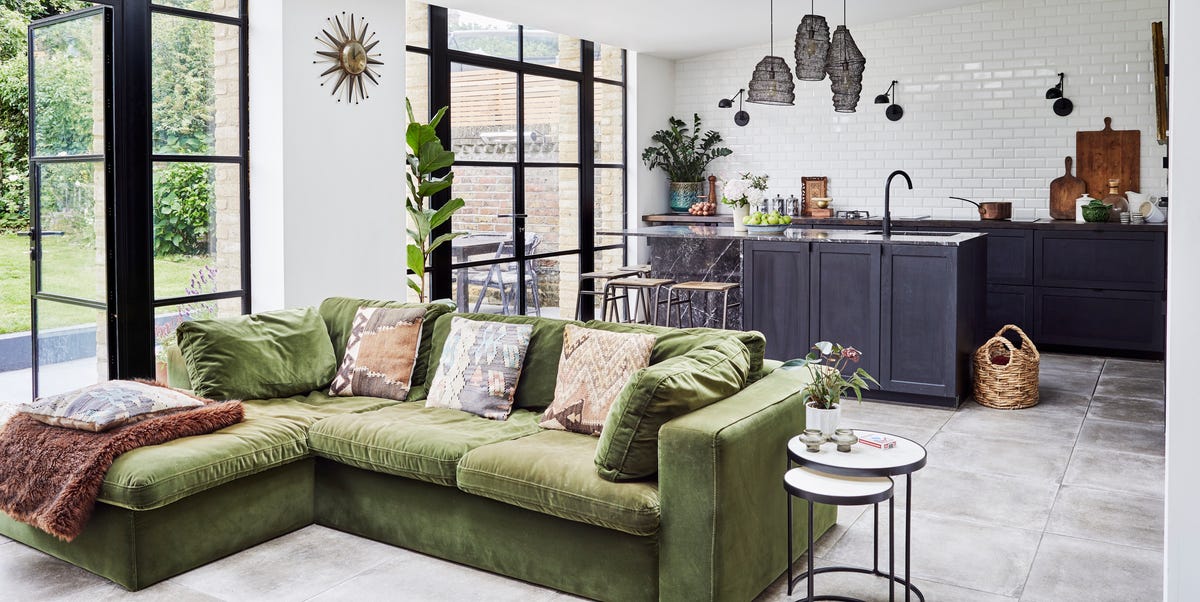
Consider natural light


A full-width extension in this renovated Victorian home in London has allowed for an open-plan kitchen and living room with floor-to-ceiling Crittall doors leading onto the garden. Although this space is large enough to take a tall and chunky divider like a bookcase or media unit, a low sofa has been chosen to maximise the flow of natural light.
Archways


Large archways are an increasingly popular way to delineate a kitchen from a living room, all while maintaining an open-plan layout. Swedish textile designer Cathy Nordström has used the same warm off-white in her living room and kitchen, creating a cohesive link between the two.
The division of space


An open-plan kitchen and living area doesn’t have to be divided equally between its two functions – the footprint of each should be dictated by use and lifestyle rather than a neat division across the centre of the room. This contemporary basement kitchen in Brighton has a subtle framing design that contains it within the larger footprint of the living area.
Narrow rooms


The temptation with narrow rooms like this is to line your furniture along its outer walls to create a corridor of space down the middle. There is, however, only so much room we need to manoeuvre around – a walkway of one metre is recommended in the kitchen – and so dividing down the middle is usually more efficient. There is no hard and fast rule about the positioning of a sofa here: it might be dictated by adjacent doors, the distance from the TV, or you might need extra floor space in the living area for little ones to play.
Pictured: Marlborough Terracotta Tile at Ca’Pietra
The kitchen island


Kitchen islands are a natural divider in open-plan spaces. You can place a sofa against an island if it only has cupboards to one side, or create a more sociable design like this one in the beachfront home of Pearl Lowe by facing your sofas toward your kitchen.
Using colour

This is a great example of using colour to distinguish between the kitchen and living room. The overall palette is totally aligned, but a blue feature wall contains the kitchen in lieu of a physical divider. This shows too why chaise sofas and L or U-shaped sofas are more effective in open-plan spaces – the right angle acts as a soft boundary defining two sides of the living area.
Pictured: House Beautiful Freya Sofa at DFS
Kitchen/dining/living

In this farmhouse-style home, a third function is introduced into the open-plan kitchen and living space in the form of a dining area. The long and narrow table has been positioned very cleverly, acting as a divider between the spaces but retaining its own function as a spot to gather and eat.
Pictured: Marlborough Terracotta Tile at Ca’Pietra
The semi open plan


Archways don’t have to be rendered in plaster – wood cladding is increasingly popular with integrated shelving that frame each side and continue overhead. Filled with books, trinkets and art, they are particularly appropriate in maximalist homes, like this Nottingham flat by interior designer Jodie Hazlewood.
A sunken floor


A sunken floor is a very retro design device. Commonly referred to as conversation pits, they were popular in the 50s, 60s and 70s – but remain effective in open-plan spaces. In the Palm Springs-inspired home of interior architect Olu Abimbola, the living area is lined with a woolly Flokati rug to create a soft and cosseting corner in a home defined by hard materials.
The circular flow


In this long and narrow farmhouse in Dorset, the kitchen, dining and living spaces are arranged consecutively, with walkways around the perimeter of the room. It creates a lovely circular flow that feels intuitive to move through and does away with dead ends or bottlenecks.
The sociable kitchen


With an island that seats seven guests, this kitchen has been designed as a truly sociable space. It would be counterproductive to close off the adjacent living room by facing sofas away from all the action – placing them at right angles to the kitchen better facilitates interaction and conversation between both areas.
Pictured: Bespoke kitchen by Olive & Barr
The XL open plan


Large, open-plan rooms can be very tricky to arrange because they can end up feeling cavernous and impersonal. It is usually more effective to fill up every inch available to you by creating lots of little pockets – like this kitchen with a breakfast bar, cosy seating nook, dining area and a window seat – rather than leaving an expanse of open space.
Pictured: Bespoke kitchen by Pluck
Follow House Beautiful on TikTok, Instagram and Pinterest

Rachel Edwards is the Style & Interiors Editor for Country Living and House Beautiful, covering all things design and decoration, with a special interest in small space inspiration, vintage and antique shopping, and anything colour related. Her work has been extensively translated by Elle Japan and Elle Decor Spain. Rachel has spent over a decade in the furniture and homeware industry as a writer, FF&E designer, and for many years as Marketing Manager at cult design retailer, Skandium. She has a BA in French and Italian from Royal Holloway and an MA in Jounalism from Kingston University. Follow Rachel on Instagram @rachelaed
Advertisement – Continue Reading Below
Advertisement – Continue Reading Below
Advertisement – Continue Reading Below
link