


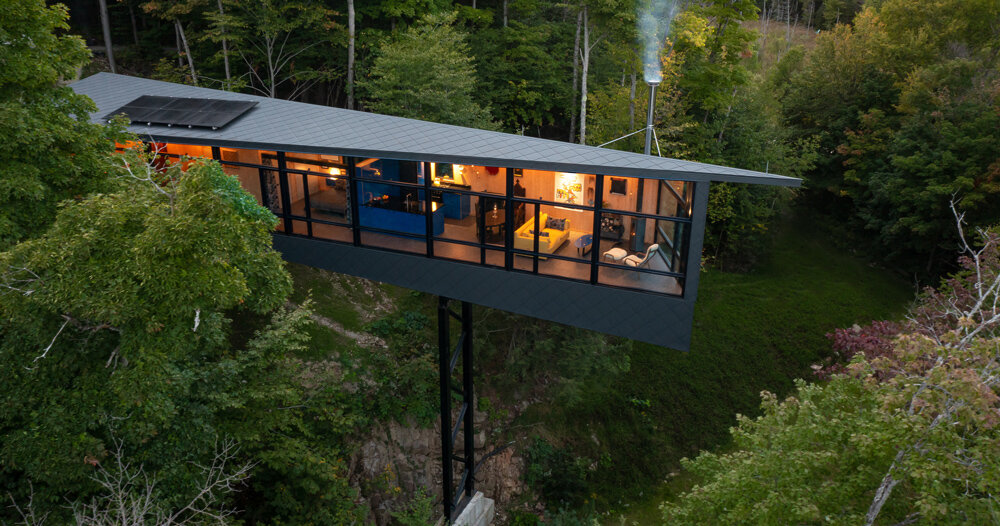
a dwelling separated from the landscape
Canadian practice Kariouk Architects celebrates the iconic log cabin cottage of the North American wilderness through a more purist — yet still contemporary — lens. The team notes that the typical modern cabin stands as a ‘woodsy’ version of the suburban home with all its modern conveniences, meaning that these buildings will only appear to be ‘at one with the land,’ suggesting a reduced environmental impact.
The m.o.r.e. Cabin inverts this idea by entirely separating itself from the landscape atop stilts, thus maintaining a more sustainable existence than other cottages. The team notes: ‘This unraveling of eco-fictions is not cynical, but optimistic: while organic environments are being degraded, what remains can be engaged more responsibly.‘
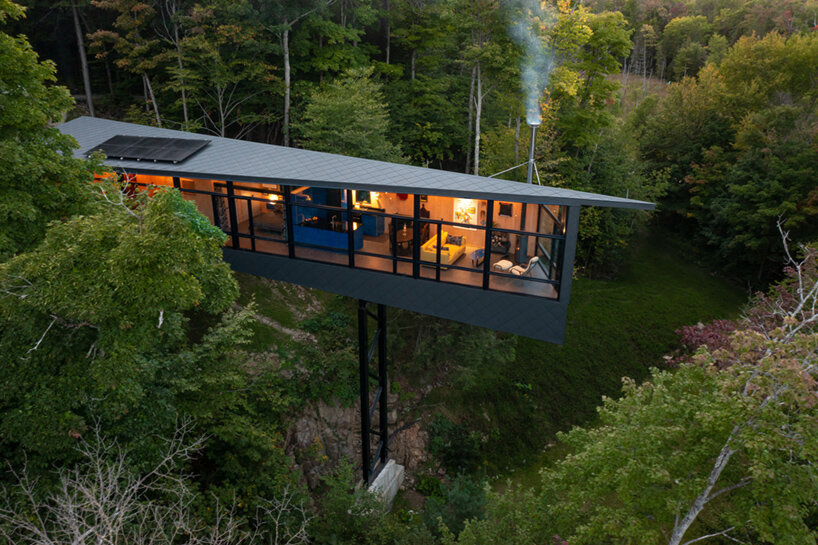

kariouk architects’ respect for the land
Kariouk Architects (see more here) designs its m.o.r.e. Cabin to touch the land lightly. The architecture is sustainably constructed with a low-waste CLT timber structure, a reduction in foundation size through a steel mast, and a system of off-grid power and high-efficiency heating. What’s more, the elevated dwelling even introduces a new home for endangered bats.
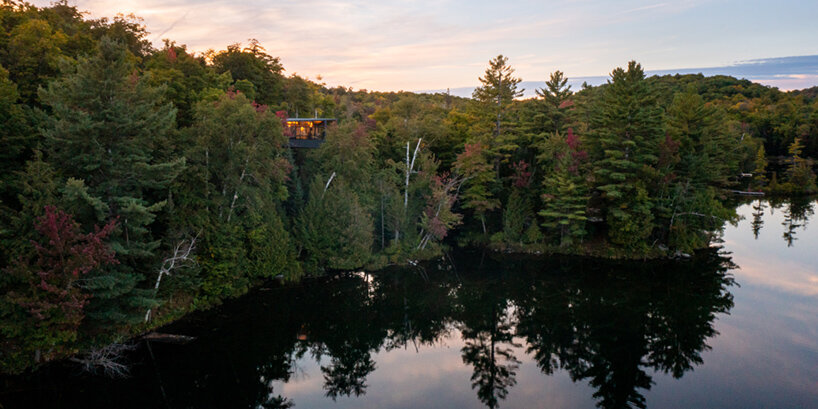

‘m.o.r.e. that one way to skin a home’
The team at Kariouk Architects perches its m.o.r.e. Cabin atop a single concrete footing and a steel ‘mast’ placed within the required setback. The architects explain: ‘Avoiding a conventional large foundation preserved the watershed and prevented erosion, as did elevate the construction zone. The use of carbon-intensive concrete was also reduced for a lower carbon footprint.
‘m.o.r.e. Cabin is built with suitably-sourced CLT panels and glulam beams. The CLT was milled offsite and then hoisted into place, avoiding damage to the landscape by the maneuvering of construction machinery.‘
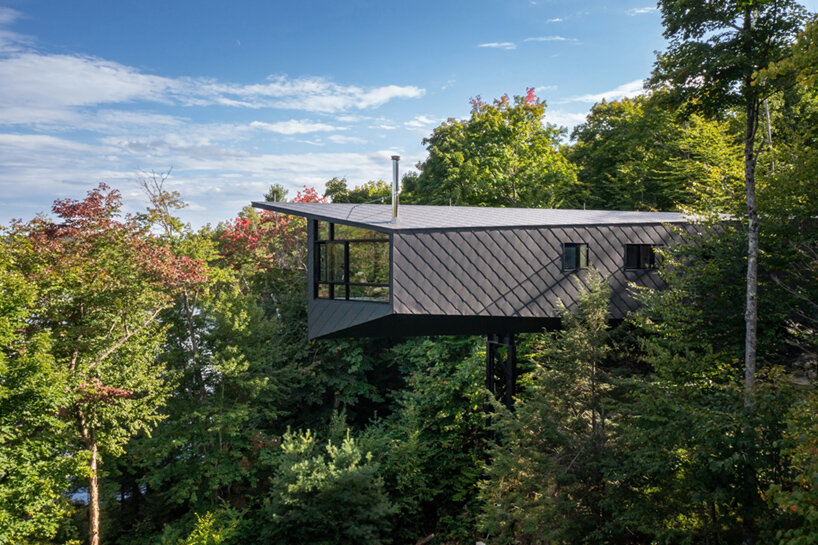
Cabin-as-Beam
The structural innovations which shape Kariouk Architect’s m.o.r.e. Cabin were informed by the group’s environmental considerations. The team continues: ‘Our challenge became to develop a structural strategy using cantilevered CLT panels as a response to the zoning variance that we obtained; CLT is fundamentally deployed in vertical/compressive sections, not horizontally in tension.
‘Conventional 5-ply CLT is too heavy to support itself over longer spans. The solution used thinner 3-ply CLT, with structural capacity ensured through “folding” (just like paper gains strength when folded).’
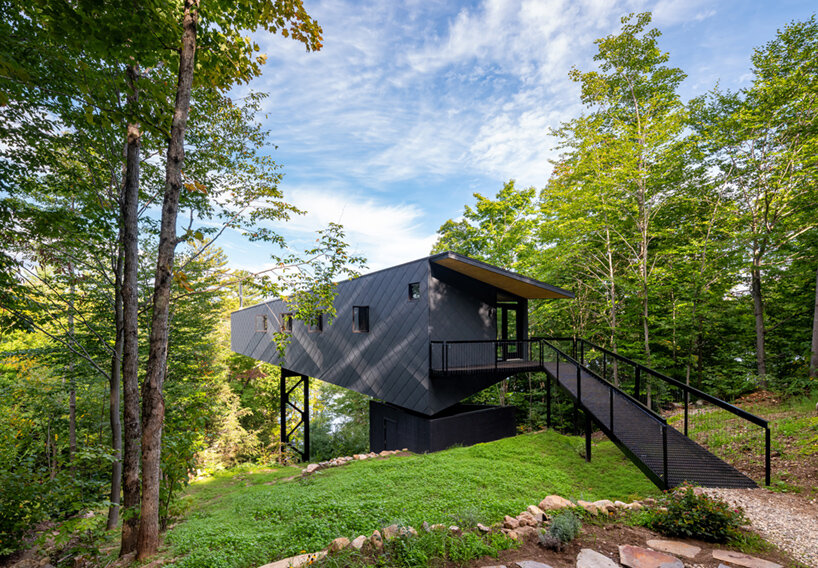

a solar-powered cabin over the woods
With its elevated perch, the breezy cabin receives excellent cross-ventilation. Interiors are heated by way of a high-efficiency ‘green carbon’ wood stove, while thermal comfort is ensured by the mass of the CLT structure. The architects comment on the home’s relationship with its nocturnal neighbors: ‘One goal of the home was to create extensive lodging for endangered brown bats. Bat pods were integrated into the mast to provide safety from climbing predators and a clear flight path to the lake.’ 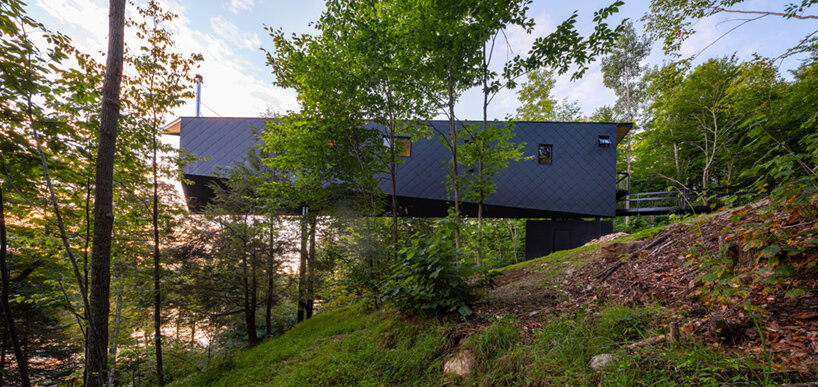

link